
Objective is the key word in this chapter. Anything that's evidence outside of your mouth and outside of my mouth is what wins.
The Inland Empire is full of it. Freeways, local roads, residential streets, gas stations, corner stores, Ring doorbells on every other house. Most of the footage of your crash is sitting on a hard drive or an SD card somewhere right now, and most of it will be gone inside a week, because the storage loops over and writes new footage on top of yours.
So the whole game is knowing what exists, and moving before it does not.
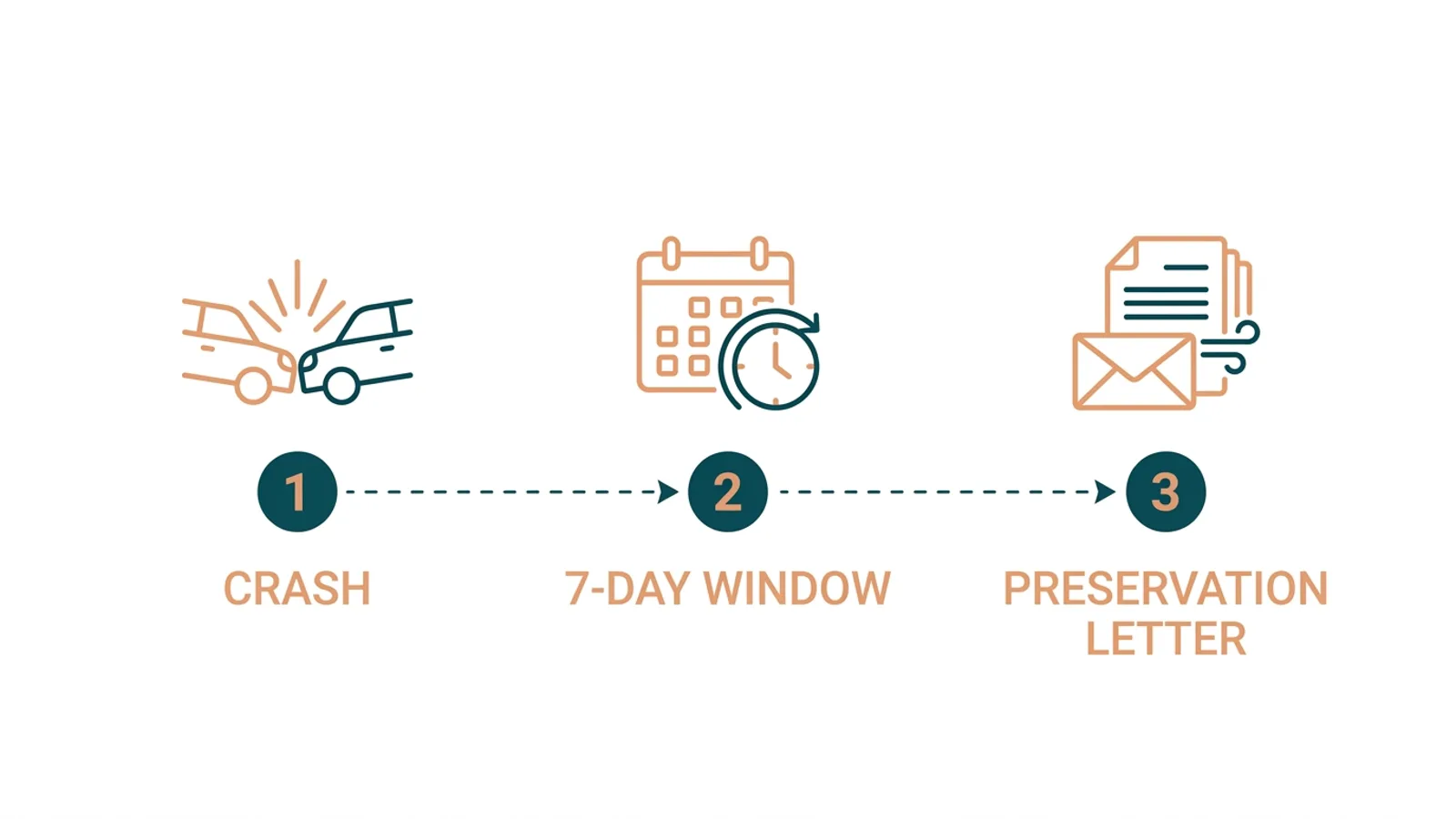
If you're going to capture that, you have to do it within, I always say safely within seven days because those recordings, they automatically loop over.
Corner stores, Ring doorbells, gas stations
There are a lot of cameras on California roads in general, whether it's the freeway or the local roads. People assume that means there's footage of their crash.
Those cameras are usually live footage. The ones along our freeways and major roads are mostly not recording anything at the time, at least not anything you could later go and ask for. You can watch the live feeds yourself on the Caltrans traffic camera network. It's usually used for a police chase, when they want to follow some kind of car somewhere and make sure they don't lose them. So the camera is there, but it is not capturing anything you can ask for later.
Local intersections are a different story. A lot of times those corner stores, or even Ring doorbells in a residential community, will capture the accident.
The first thing to do at the scene is look around you. If you notice there are any cameras, take a picture of the cameras. The lawyers will want to see where they are, so if we send out a private investigator we can show them the photo and say, that camera, go to that camera, ask them for the footage.
The bigger stores won't really cooperate. You may have to just be very nice and tell them the situation. You may even have to pay them something to get that footage, because they have no obligation to do it unless they're a good Samaritan who volunteers it. On a road like Hamner, where all the businesses are, there are usually plenty of options.
There's a local shortcut I use, and I'm giving it away because it works. If you've been in Norco a while, you normally know somebody who knows somebody. If you don't, reach out to the Norco Rotary Club. I'm the secretary there. A lot of the business owners are members, and we meet every Thursday morning at Polly's Pies on Hamner at 7:15. Somebody there will know somebody who probably owns one of those stores and can get you that footage.
Residential footage is usually easier, because the residents around here are very nice and more than willing to help you. Some of them are not so tech savvy. They may have had it installed by a grandkid, so don't be surprised if somebody hands you their phone and has you go find the clip yourself.
You have about seven days
Every one of these systems loops over, because nobody has infinite storage. I would say it's usually around seven days. Sometimes more, sometimes less. I gauge around seven days before it gets recorded over.
Some of our cases run up to five years depending on how intense they get. The footage is not going to be sitting in an SD card waiting for us that whole time.
If you can't get it in person inside that window, the answer is an evidence preservation letter. It notifies them, puts them on notice that this footage needs to be saved. We'll deal with it later, we'll grab it later, but at least save it right now, put it aside, because we may need it for litigation purposes.
Here's why that letter has teeth. If the defendant has footage and they choose to delete it even after receiving that notice, we can use that against them in court. It's called spoliation of evidence. They deliberately chose to erase it, and the jury can do what they want with that information. Preservation work like this is routine for a bicycle accident attorney or a pedestrian accident lawyer, where roadside camera footage is often the whole case.
And move faster than you think you need to. We had a client whose accident happened in a residential community, with all the houses facing the street, and one house caught the whole thing on a Ring doorbell. The owner was an older lady. When our client went over to ask her to share it, she told him the other driver had already come by and gotten a copy. She didn't really know how to use her app, and when our client went through it looking for the clip, it was gone. The defendant got to her first and deleted it.
It's sad, but it does happen. Which is why a polite, direct request on day two beats a perfect legal letter on day nine.
Commercial trucks almost always have footage
Commercial trucking companies install dash cams because their insurers incentivize it. If the company puts dash cams in their fleet, their premiums go down.
The reason that incentive is so strong is the size of what's behind it. When we're talking about commercial trucks, those policies are usually like a million dollars, against the $30,000 and $15,000 minimums an ordinary passenger vehicle carries under Chapter 4. With that much exposure on one claim, a carrier has real money riding on being able to show its driver wasn't at fault. So most of those trucks have dash cam footage, and that footage exists whether it helps them or helps you.
Getting the preservation letter to the right place is where people go wrong.
Go to the California Secretary of State website. Whatever the company name is on the registration or the insurance card, look that entity up. Click on it, and on the right hand side it will show what's called the agent for service of process. That's the specific person or entity legally designated to accept legal documents on that company's behalf, and that's the address the letter has to go to.
You can't just give it to anybody at the company. Let's say it was a Costco truck. You can't go to your local Costco and hand them the letter. It has to go to whoever has been legally designated to accept legal documents on behalf of that company.
Building the corroboration chain
Beyond footage, the useful list is short and practical. Witness statements are always helpful. Police reports can be helpful. Repair estimates can be helpful. And depending on how big your case is, the attorney will hire an accident reconstructionist, who takes the photos and videos of how the cars were positioned after the crash and determines how it happened.
That's another reason the scene photography in Chapter 1 pays off long past the first phone call, and it's exactly the kind of analysis that turns up the thin argument for shared fault described in Chapter 5. It's also the independent proof that matters most once a case gets disputed enough to land in front of the arbitrator or judge in Chapter 11.
The way I think about all of it's as a chain. A single link, one piece of evidence by itself, might be weak. But when you build a corroboration chain, it becomes unbreakable. You take the police report, layer it with scene photos, lock it in with video footage, back it up with an independent witness statement, and anchor all of it with medical records. The more links we have, the stronger it holds.
That matters because one of those links is weaker than people assume. As Chapter 11 explains, a police report is technically hearsay and can't simply be handed to a jury. An officer's own scene photos never come back with the report we order. Camera footage, witness statements, and your own photos and video don't carry that limitation, which is why moving on them quickly is worth doing even when a report already exists.
The cheapest insurance policy you can buy is a dash cam
If you haven't been in an accident yet and you're just reading ahead, here's the one thing to do with this chapter.
Get a dash cam. You can get it on Amazon and it's so cheap, twenty or thirty dollars.
Make sure it comes with an SD card. A lot of these dash cams don't, and if it does not, buy the card and put it in. Otherwise there's no point in having it up there. It's recording nothing. It's the same as the live footage cameras on the freeways and the roads, a camera that is not capturing anything.
I always tell clients this, usually after the fact, when a dash cam would have saved us six months of argument. It is not going to help you this time, but if something happens in the future, it will protect you then.
And if you're reading this after the fact with no dash cam installed, the phone video habit in Chapter 1 is your substitute at the scene.
Common Questions
- Do traffic cameras on Inland Empire freeways record footage of accidents?
- Usually not in a way you can request later. Most are live footage, used for things like following a vehicle during a police chase, rather than continuous recorded storage. Nearby businesses and residential Ring doorbells are far more likely to have usable footage of your specific crash, which is why looking around at the scene matters.
- How quickly do I need to request nearby camera footage after a car accident?
- Safely within seven days. Those systems loop over automatically because the storage is limited, and once it writes over your crash it's gone. If you can't retrieve it yourself in time, an evidence preservation letter puts the owner on formal notice to hold it.
- Why do commercial trucks almost always have dash cam footage available?
- Because their insurers incentivize it. If a company puts dash cams in its fleet, its premiums come down. The stakes justify it, since commercial truck policies usually run around a million dollars against the $30,000 and $15,000 an ordinary car carries. With that much on one claim, the carrier wants footage proving its driver wasn't at fault.
- What happens if a company deletes dash cam footage after receiving a preservation letter?
- It becomes spoliation of evidence. They deliberately chose to erase something after being put on notice, and the jury can do what they want with that information. That's exactly why the letter goes out early and goes to the registered agent for service of process, not to whoever happens to answer the phone.
Chapter Reflection
Evidence out here doesn't wait for anybody to get organized. The footage loops, the witnesses scatter to get their kids, and the cars get repaired or hauled off to a salvage yard. Everything in this chapter is the same idea told five ways. The proof exists for a window, the window is about a week, and somebody has to move inside it. Usually that somebody is you, with a broken car and a sore neck and no idea any of this clock is even running. So before you leave the scene, look around and take a picture of every camera you can see. The corner store, the Ring doorbell across the street, the gas station on the opposite corner, things of that nature. Then hand those photos to somebody who can go knock on the doors this week.