
Nobody thinks about the first few minutes after a car accident until they're already in one. The ears are ringing a little, the hands are not quite steady, and somebody behind them is already leaning on the horn. That's what shock and adrenaline do, and nobody should feel bad about it.
Here's the problem. Everything that comes after, the claim, the adjuster, the fight over whose version the insurance company decides to believe, gets built out of whatever you managed to capture while you were standing in the road. Not out of what you remember three weeks later when you finally call us. Out of what you documented that day.
So this chapter is the sequence I want you to have in your head before you need it. Safety, then records, then the police, then the exchange. Some of it you already know. Two or three pieces of it almost nobody thinks about in the moment, and those are usually the ones that decide whether a claim is clean or whether we spend the next year arguing about it.
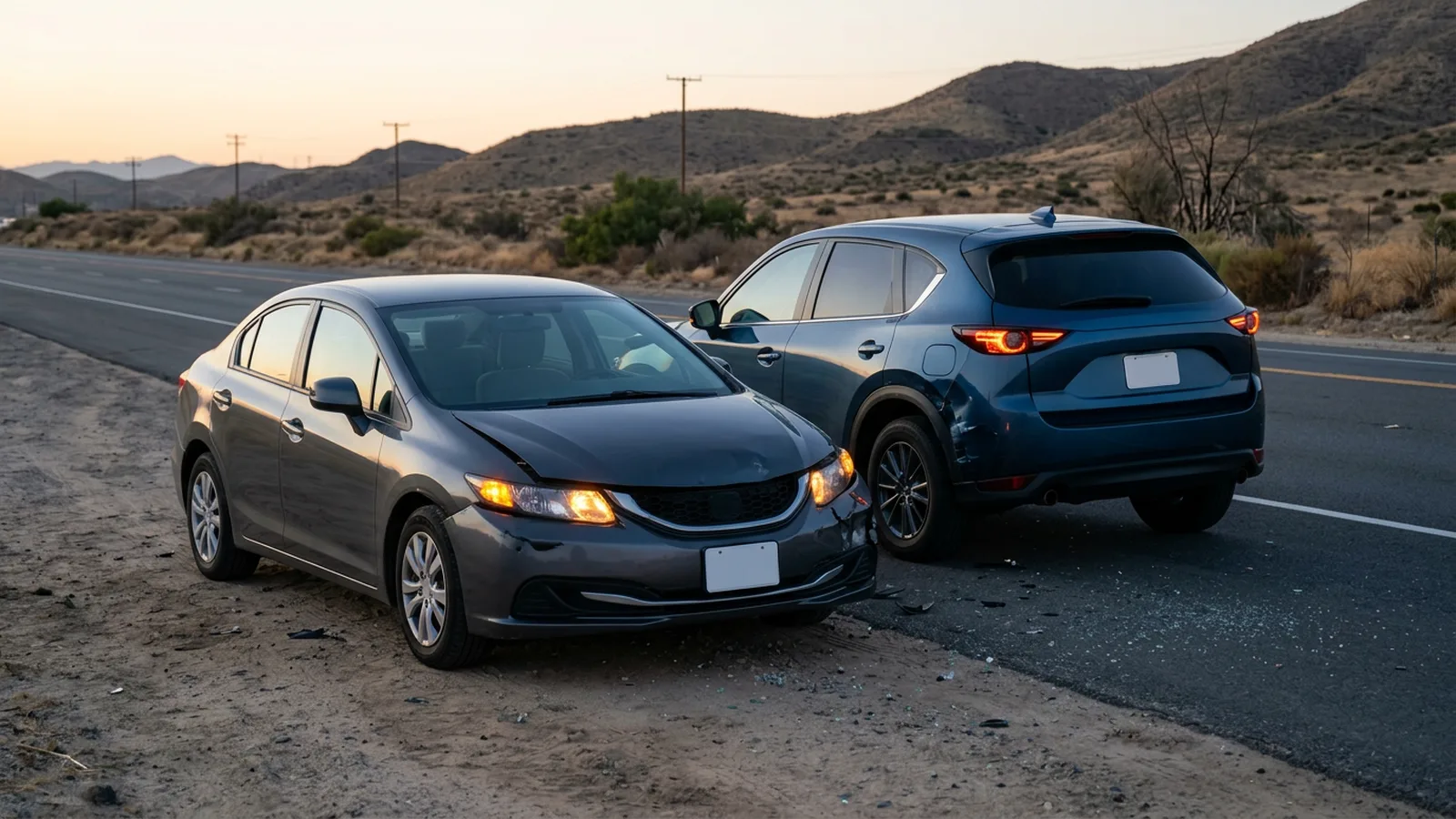
It's always nice to be able to get out of the car as is and then take pictures and videos of the vehicles exactly as they came to rest after the accident. If it's a dangerous situation and there's cars moving around, then go ahead and pull over. But if possible, always collect the photos and videos of how the vehicles came to rest after the accident.
Photograph the cars before anybody moves them
First things first, ensure safety. Make sure everybody can get out of the car.
After that, the instinct almost everyone has is to clear the road. If the scene is already safe, I want you to do the opposite. Let's say there's no traffic hazard, nobody is bearing down on you, and you can step out. Leave the vehicles exactly where they came to rest and take pictures and videos of them first. Then you move them over to the side.
If it's a dangerous situation and there are cars moving around you, go ahead and pull over. Then take the videos and photos afterward. Your safety comes before any of this. But if it's possible, always collect the photos and video of how the vehicles came to rest.
The resting position of a car is evidence of how the accident happened, and it's evidence that stops existing the second somebody moves a bumper out of habit. Later on, if the police never come out and it turns into a he said, she said situation, those photos are what an accident reconstruction expert works from. Depending on how big the case is, we may hire one to take the images and the video and reconstruct the crash in an animated format showing how it happened. Nobody can reconstruct anything from a memory.
Say you're hurt, even if you're not sure yet
I think the decision point that trips up more people than anything else in this chapter is whether to tell the responder you're injured.
Call the police. And when they ask, tell them you're injured, even if you are not feeling anything at that moment. Right when the accident happens you have an adrenaline rush, so usually you won't feel anything.
If you tell them you don't have any injuries, a lot of times they'll refuse to come out. They'll tell you, "Okay, well, you guys just exchange information then. We are not sending anybody out." No officer means no official police report. And no police report means the other driver now has an open field to tell their insurance company a completely different story about what happened, weeks later, with nothing on paper to contradict them.
This matters more in some parts of the Inland Empire than others. In San Bernardino County, more likely than not the police are not going to come out at all, and I think that's just the crime rate over there. They're busy. Riverside is a lot better about it. But in either county you still usually need to say you're hurt or they won't send anyone. If they still won't come, you can call and ask them to send paramedics, which sometimes brings an officer out with them. And if nobody comes at all, then everything in the section above becomes your only record.
Your phone is the dash cam you already have
A lot of our clients, and almost everybody going through this for the first time, don't have a dash cam. If that's you, there's something else you can do.
When you get out of the vehicle and you go to talk to the other driver, pull out your phone where they can plainly see it, turn on the video, and start recording that person and any conversation you have with them.
Sometimes I've seen the other side stand there and explain exactly what happened, and a lot of times that will help with the liability dispute. Let's say it's a lane change situation, where they later claim you changed into their lane and you're saying they changed into yours. If you have that conversation on video, it helps a lot. Video does not blink and it does not forget. We do.
One requirement governs all of this. Make it clear that the recording is happening, because California is a two party consent state. Openly, phone up, out loud. That's the whole rule.
The photo almost nobody takes
Once you've documented the scene and moved to a safe spot, you exchange information. When I say exchange information, I mean more than trading phone numbers.
I want a photocopy or a photo of their registration and their driver's license. Take a picture of their license plate. And here's the one people miss: even if it's a rear-ender and they just rear-ended you, take a photo of the back of their car.
A lot of times I hear the other driver tell their insurance company later that somebody rear-ended them and pushed them into you. A ghost car. And a lot of the time our clients don't have pictures of the back of that vehicle, because why would you take a picture of the back of a car that hit you from behind? But if you have a photo showing no damage back there, it becomes very hard for the other side to keep trying to prove that up.
If there are any witnesses, collect their contact information, even the ones already walking back to their car. They have work to do and kids to pick up, and most of them can't wait an hour or two for an officer. A name and a phone number is enough. We can figure out what they know later.
I know you're probably frazzled, and it's genuinely hard to hold a checklist together in your head while you're shaken up. So don't hold it in your head. Write this list down once, right now, while nothing is happening, and put it in your glove compartment. When you get into an accident you're going to reach into that glove compartment anyway for your registration and your insurance card. Pull the list out with them and just check things off before you leave the scene.
Do all of this before the officer arrives
This is the part that runs against everyone's instinct, which is to call 911 the second a crash happens. The instinct is wrong, and the reason is mechanical rather than legal.
Take your photos and video, and talk to the other driver if it's safe to do so, before the police come out. Then when the officer arrives, let them do whatever they need to do.
A lot of times if you call law enforcement first and they show up, they won't allow you to walk around taking pictures, and they'll do all the talking with the other side themselves. You lose the window.
Officers do take their own photos at the scene, which sounds like it should solve the problem. It doesn't. When we order the police report afterward, it never comes with pictures. I don't know what happens to those photos. My guess is that it's just for their own memory when they sit down to write the report, like an internal memo they keep for themselves. Whatever the reason, whatever pictures they take are not in the police report we receive. Which means your own photos and video, taken before anyone in a uniform arrived, are the only images you're guaranteed to still have.
Pileups on the I-10, the I-15 and the I-215
We have the I-10, the I-15 and the I-215. All of these freeways are interstate travel, and you can see it as you're driving: usually one or two lanes fully backed up with commercial carriers.
That's the setting for the multi-vehicle pileups we handle on these corridors, and a pileup is where the habit in this chapter earns its keep. In a five-car pileup, the presumption is that the car in the very back started the chain reaction. If you were the car in front, that means you should have felt exactly one impact. If you felt two, somebody in the middle hit you before the back car pushed everyone forward, and now there are two insurance policies in play instead of one. Chapter 11 goes further into how that gets sorted out. What decides it is physical evidence, and the resting positions of five cars are the physical evidence that disappears first.
And if you're reading this before anything has happened to you, get a dash cam. You can get it on Amazon and it's so cheap. Make sure it comes with an SD card, and if it does not, buy the card and put it in, because otherwise it's just a camera recording nothing. Then you can be more rest assured when you're driving around.
Common Questions
- Should I move my car out of the road right after an accident in California?
- Only if it is not safe to leave it where it is. If the scene is safe, photograph and video the vehicles exactly where they stopped before anything moves, because that positioning is evidence. If traffic is still coming through the crash and staying put is dangerous, pull over first and document afterward. Safety comes first either way, and the documentation happens as soon as it's safe to do it.
- Do I have to call the police after a minor car accident in the Inland Empire?
- You are not always required to, but I recommend it every time, and I recommend saying you may be injured even if you are not sure. If you tell them you have no injuries, a lot of times they'll refuse to come out at all. Without a police report, the other driver has much more room to change the story once the insurance companies get involved.
- Is it legal to record the other driver after a car accident in California?
- Yes, as long as the recording is done openly, because California is a two party consent state. Pull the phone out very obviously rather than secretly. It can settle a dispute over how the crash happened, especially in a lane change situation where each driver says the other one changed into their lane.
- Why should I take a photo of the back of the other driver's car if they rear-ended me?
- Because a lot of times the driver who rear-ended you tells their insurance company that somebody else rear-ended them first and pushed them into you. A photo showing no damage to the back of their car takes that argument away before an adjuster ever hears it.
- Should I take photos and talk to the other driver before or after the police arrive?
- Before, if it's safe. Once officers arrive they usually won't let you keep photographing, and they do the talking with the other side themselves. Officers take their own photos, but when we order the report afterward it never comes with pictures, which makes your own records the version you can actually count on having later.
Chapter Reflection
Document everything. I know that's hard to do in the moment, because you're full of adrenaline, you don't know what's going on, and it's hard to think. That's the whole reason I want that list in your glove compartment. You're reaching in there for your registration and your insurance card anyway, so pull the list out at the same time and check things off before you leave. None of it takes more than a few minutes and none of it costs anything. Photos of the cars where they came to rest, a photo of the back of their car, a name and a number for anybody who stopped, things of that nature. A year later, when somebody is arguing with you about what happened that day, that's the file we're working from.