
Most people think a car accident claim is the repair bill plus the medical bills. Usually that's where the list stops in their head.
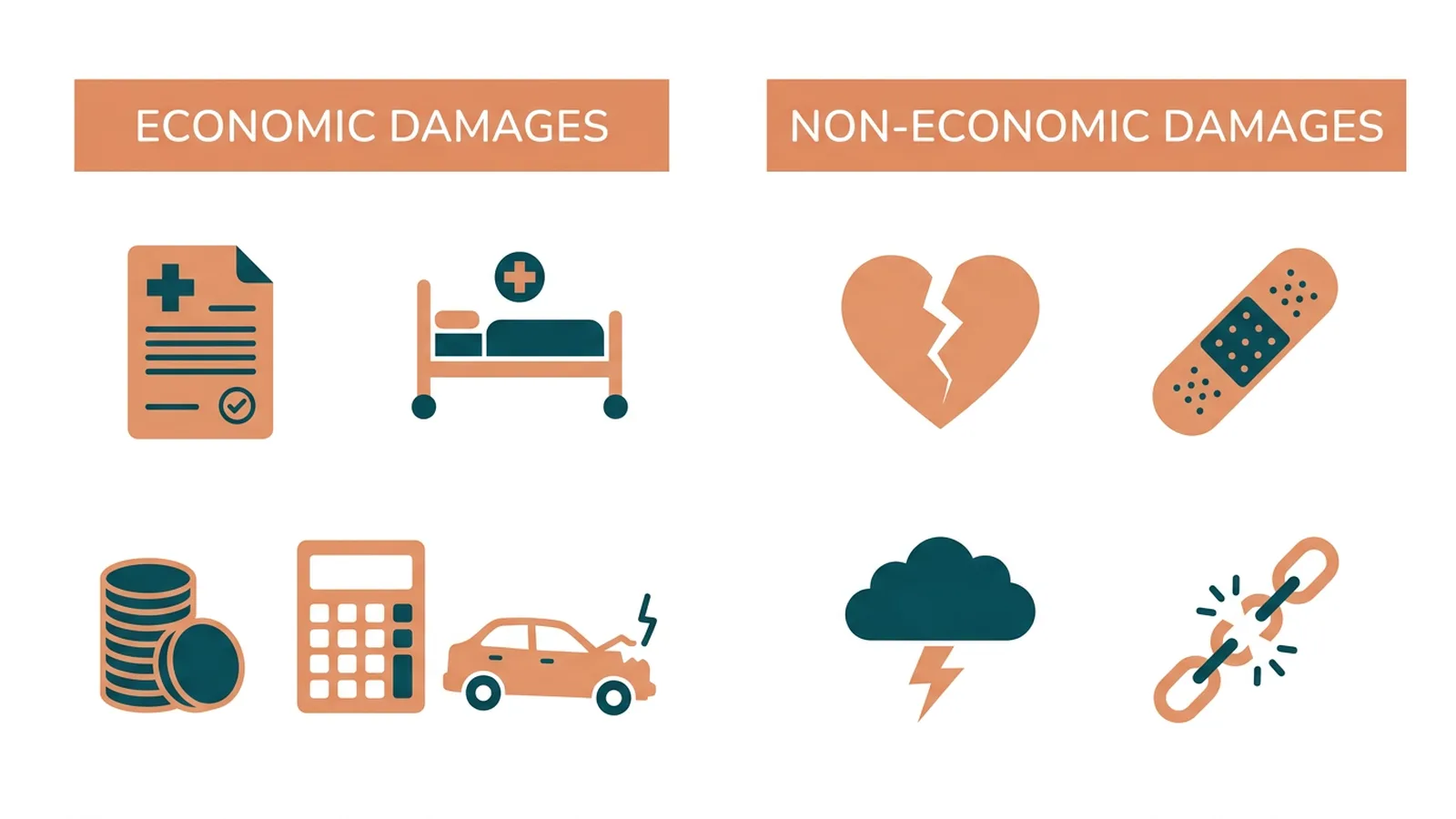
There's a lot more on it than that. There are two legal words we use, economic damages and non-economic damages, and technically a third one called punitive damages. Inside those categories are several things that clients never think to ask for, and a couple that most firms in California don't bother pursuing at all.
Some of the smallest items on that list are the ones that show you what we're measuring. How much is it worth to have pain brushing your teeth. How much is it worth to have trouble bending over the sink washing dishes. Those are the examples I give people, because that's the work. We sit down with you and go through what your week looks like now.
How much is it worth when you have pain brushing your teeth for two minutes, or how much is it worth if you have trouble bending over the sink for 30 minutes, washing the dishes, things like that? So those are things that we take into consideration.
If you can punch it into a calculator
You can think of economic damages as something economical, something that can be calculated based on economics. If you can whip out a calculator and punch in a number, it belongs here.
Medical bills come first, and not just the ones already incurred. Future medical bills count too, if a doctor has told you that you'll reasonably need something down the line. Whether you end up getting it or not, that's still an economic damage.
Lost wages are calculated by multiplying the time you had off work and showing pay stubs for what you were making before the accident compared to what came in while you were out. The difference is yours.
And here's a piece people never raise on their own. Let's say you ran out of sick pay and had to call off, so you used holiday pay or PTO instead. Technically you don't have a lost wage, because you still got paid. But the way we look at it, you have now lost your chance to use that holiday pay or PTO for something else, unrelated to the accident. It's being depleted. So we want that back.
Property damage sits here too. Repair estimates from appraisers and inspectors have a number on them. So does a rental from Enterprise or Hertz or whoever you end up with. Out of pocket costs count as well. Your deductible is one, and that can run $500 or $1,000, and I've seen it as high as $2,000. Rideshare receipts for getting to medical appointments when you have no car count too.
These are the solid foundation of a case, because they're documented in black and white. It's easy for us to calculate and it's easy for the other side to see where the number came from.
Every day without your car is worth something
This is one a lot of attorneys don't do.
Sometimes, especially when the other side is disputing liability and not accepting that they're at fault, they'll refuse to fix your car. And if you don't have collision coverage under your own policy, you have no choice but to wait for them to accept liability.
Sometimes that takes months. Sometimes it takes years. And every single day you're without your car, it's adding value to that particular claim.
There has been a case where I filed a lawsuit just for the loss of use of the vehicle, because they didn't accept liability for almost a year. That one was tens of thousands of dollars.
A lot of times that stretch is when a client feels like nothing at all is happening on their case. Nothing is moving, nobody will commit to anything, and you're getting to work some other way for the eighth month running. Meanwhile that's eight months we should be putting a number on.
The 30 to 60 day clock inside GAP insurance
If your car is totaled and the payout is worth less than the balance left on your loan, because you bought the car when it was worth more or the salesman sold it to you too high, that shortfall is what GAP insurance covers.
There's a deadline buried in it that almost nobody knows about.
Once the accident happens, you have either 30 to 60 days, depending on what the GAP insurance contract says, to open and finalize the claim. If you don't send them all the documents they ask for within that window, they won't cover whatever is upside down and outstanding on your loan.
Then even after the total loss is figured out, all the money from the total loss goes to the lienholder, and you're still left with a bill and monthly payments.
That's a pretty crappy situation, and the whole thing is a paperwork problem, so we watch the GAP paperwork the same way we watch the medical side.
The car is fixed and it's still worth less
This is the one I think we might be the only firm doing.
The law on a basic car accident is that if somebody has hurt you and caused damages, they need to put you back in the place you were before the accident happened. They need to make you whole.
The insurance companies like to claim that when they fix your car, they've done that. It looks fine. They fixed it.
But when you go to CarMax or wherever else to sell it, now it shows you were in a car accident. Even if they fixed it immaculately and it was just a fender bender, that fact alone lowers the value of the car. A similar car that has never been in an accident is worth more.
So we get compensation for that too. We hire an expert to find out how much the car would have been worth without the accident and how much it's worth now because of the accident, and we ask for the difference. If we have to litigate it, we will.
Nobody sends you a bill for this one, so it does not occur to people to ask for it. But let's say your car would have sold for a certain number without an accident on its record, and it sells for less with one. That gap is money you are owed. We just have to go prove what it is.
How your day to day has changed
Non-economic damages are the things that can't be calculated economically. Pain, suffering, emotional distress. Those are the common words people use.
But it's more about how the accident has affected your day to day.
When we send out our settlement proposal letter, we talk to you first and make sure we capture how your lifestyle has changed. And even if the injury is not bad, you'll be shocked to see how much you've adjusted yourself. You think, I'm not in pain anymore. A lot of times it's because you changed the way you do things, so you are not feeling those symptoms, not using that muscle, not triggering it.
You can't really put a dollar amount on that. How much is it worth to have pain brushing your teeth for two minutes. How much is it worth to have trouble bending over the sink for 30 minutes washing the dishes.
But that's exactly what we take into consideration when we're working out what a case is worth, and it's a huge portion of the claim. It's also the portion a driver who was uninsured at the time of the crash loses entirely under Proposition 213, which is why the previous chapter spends so long on getting your coverage confirmed.
When punitive damages come into it
Punitive damages are there to punish the other side for doing something intentionally. The legal standard is oppression, fraud, or malice, and malice includes a conscious disregard for other people's safety.
The common ones are a hit and run, where the driver chooses to leave the scene, and driving under the influence, where the driver decided to get behind the wheel that way. These are more on the rare side.
I've had a case where the Uber driver kicked the passengers out and said, 'you gotta go' after the car accident... I think it's because the clients were saying that the driver seemed to be smoking marijuana because there was a smell of marijuana from the car, and I think they were worried, so they kicked them out of the car and left them there.
That's the kind of conduct I think punitive damages are looking for. The accident was already over. Then the driver decided to put hurt people out on the side of the road. And it's a separate pot of money from your own damages, because the point of it is to punish the employer and make them think twice about doing it again.
It also points at a wrinkle that standard car accident claims don't have. In a rideshare accident the person who hit you was working. There's a company behind them with its own policies and its own reasons for how it handles a claim.
Common Questions
- What types of damages can I recover in a car accident claim in California?
- Three categories. Economic damages cover medical bills past and future, lost wages and property damage. That last one includes loss of use while your car is unavailable and the diminution in its resale value. Non-economic damages cover pain, suffering and emotional distress. And in rarer cases involving intentional conduct like a hit and run or a DUI, there are punitive damages.
- What's diminution in value in a crash claim?
- It's compensation for the fact that a car with an accident on its record is worth less when you sell it, even after a flawless repair. The insurance company says fixing the car made you whole. The day you go to sell it, you learn otherwise, because now the report shows an accident. We hire an expert to establish what the car would have been worth without the accident against what it's worth now, and we ask for the difference.
- What's loss of use compensation, and when does it apply?
- It applies when a client is without a working vehicle because the other side is disputing liability and there's no collision coverage of their own to fall back on. Every day without the car adds value to that claim. I've filed a lawsuit just for loss of use in a case where they didn't accept liability for almost a year, and that one was worth tens of thousands.
- What's GAP insurance, and why does the timing matter after a total loss?
- GAP covers the difference between a totaled car's payout and what's still owed on the loan. The contract usually gives you 30 to 60 days from the accident to open and finalize the claim. Miss it and they won't cover what's upside down, the total loss money goes to the lienholder, and you're left making payments on a car you no longer have.
- Can I get compensated for lost sick days or vacation time I used after a crash?
- Yes. You technically got paid, so there's no wage gap on the pay stub. But that sick pay, PTO or holiday pay is now depleted and you can't use it for something unrelated later. That loss belongs in the claim, and it's one people almost never think to raise on their own.
Chapter Reflection
The economic side of a claim mostly documents itself, because the paperwork already exists. Even there, loss of use and GAP have their own deadlines that people find out about the hard way. For the non-economic side we sit down with you before the demand letter goes out and go through the week. What you stopped doing. What takes longer now. What you handed off to somebody else. Who does the grocery run, whether you can still get down on the floor with your kid, things of that nature. Usually people are surprised by their own answers.