
Most people never find out how low California's minimum coverage is until a crash makes them find out. By then it's too late to have carried anything else.
California uses a fault based system. That means the at fault driver and their insurance are responsible for your damages. You file a claim with the at fault party's insurer, and you can also use your own coverage for certain benefits depending on what's available under your own policy.
That sounds clean. Here's the part that is not. Sometimes even if the at fault party has accepted liability and their insurance company says they're willing to pay, they simply don't have enough in their policy to pay for everything that's required for you and your car.
The at-fault driver's insurance pays first, when there is enough of it
Under a fault based system, the claim goes to the at fault driver's insurer.
A driver can be completely at fault, admit it, have their carrier accept liability, and still be carrying a policy far too small for the damage they just caused. Liability and coverage are two different questions, and people conflate them constantly. Winning the first one does not get you paid. It only tells you who you're collecting from.
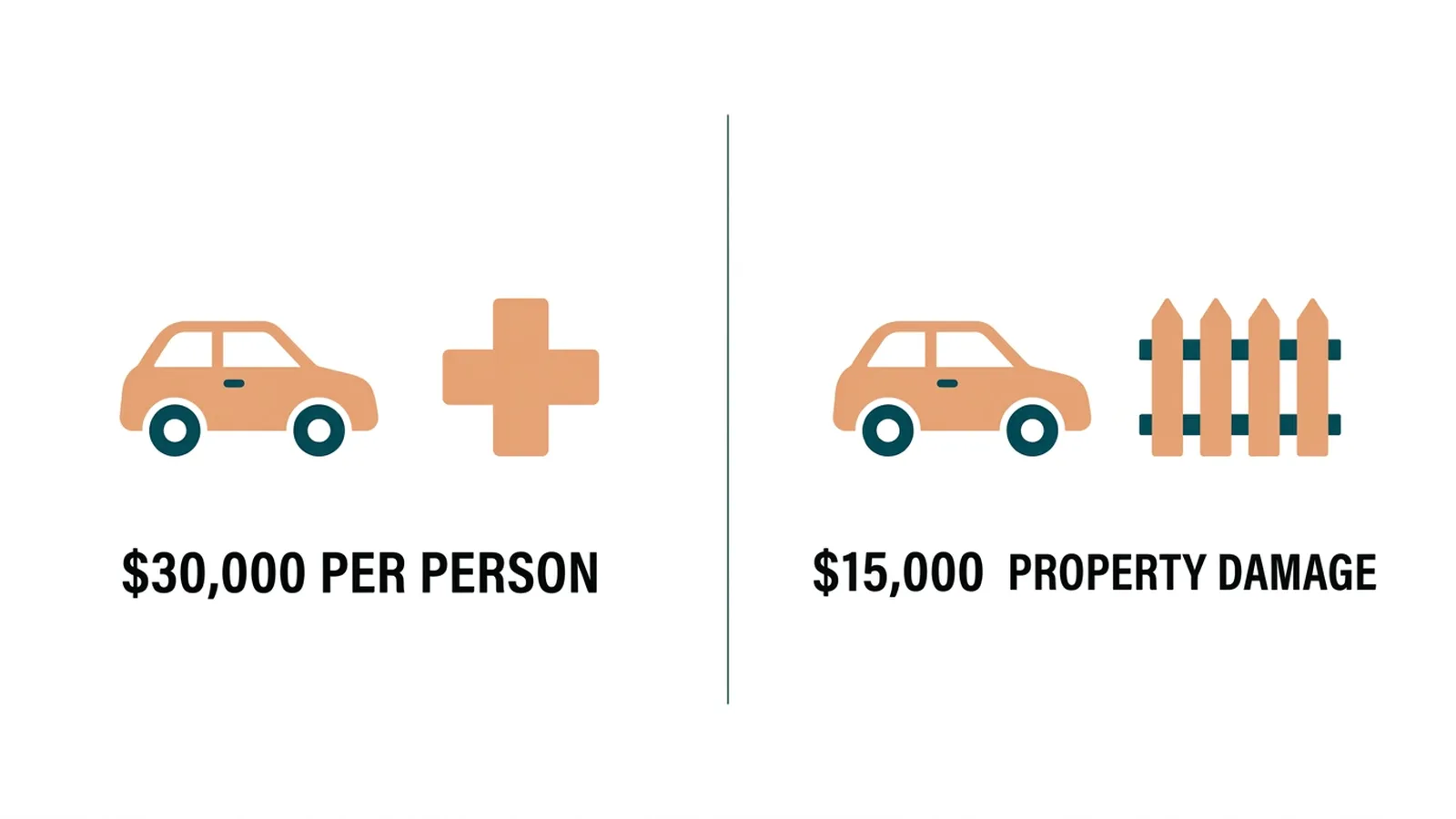
California's minimum auto insurance requirements is $30,000 per person and $60,000 per accident for bodily injury. And then for property damage, it's $15,000 for all the cars involved, if not including the at-fault driver. So this would include any other vehicles involved.
Thirty, sixty, fifteen
Three numbers. $30,000 per person and $60,000 per accident for bodily injury, and $15,000 for property damage.
The property damage number is the one that surprises people. That $15,000 is shared across all the other cars involved, not the at fault driver's own. So let's say it was a two, three or four car pileup. That $15,000 gets split among all of them. Cars these days, even the repairs are worth more than $15,000 on their own. Four cars needing $8,000 of work each is $32,000 of damage sitting against a $15,000 pool, and everybody involved is fighting over the same money.
These limits matter because they set the minimum coverage that drivers are required to carry. But a lot of the time the damages our clients sustain, the full list of them in Chapter 7, exceed those amounts by a wide margin.
When they do, the additional compensation has to come from somewhere else. There are two places. It comes from the at fault driver's personal or commercial assets, which means a lawsuit. Or it comes from your own underinsured motorist coverage.
Suing the at fault driver personally is the remedy the law allows, and it's worth exactly as much as that driver owns. A judgment against somebody with nothing to collect is a piece of paper. That's why I treat your own coverage, and not a lawsuit against a stranger, as the dependable answer.
The scale of the problem is easy to picture with real numbers. If someone gets hurt by a regular person driving around the 10 freeway or the 15, somewhere around Loma Linda or anywhere in the IE, they are not driving around with more than $100,000 worth of coverage. A hundred thousand is already the high end for around here. On the low end, which is the most common, it's the California minimum. So if you have a $40,000 ER bill and the other driver only has $30,000, that's a pretty easy pop. That claim resolves quickly because there's nothing left to argue about.
Why you may never learn what the other driver is carrying
There's an asymmetry here that I deal with on every single case.
My own client's insurance company has a legal obligation to give us a copy of whatever we ask for that belongs to our client. The other side does not. The insured, meaning the defendant driver, has no legal obligation to us at all. They don't owe us any disclosure of what their policies are.
We still ask. When we do, the insurance company sends a letter out to their own insured asking them to sign off and authorize disclosure of their policy limits.
And 99 percent of the time, that never happens.
So you can go most of the life of your claim without knowing whether the person who hit you was carrying the state minimum or a policy ten times that size. That uncertainty is exactly why the two options above, a lawsuit through the litigation process in Chapter 11 or your own underinsured motorist coverage, have to be live possibilities rather than afterthoughts.
Don't shop for the cheapest premium
This is the part of the chapter I would keep if I had to cut the rest.
Make sure you have medical payment coverage under your own insurance company. And make sure you have uninsured and underinsured motorist coverage under your own policy.
Don't always look for the cheapest premium, because the cheapest premium is not protecting anybody. It's just the insurance company taking your money, and then when the time comes that you need it, they tell you, you don't have that, you don't have this, we can't do anything for you, things of that nature.
Medical payment coverage is a separate piece most drivers never think to ask for. Uninsured and underinsured motorist coverage is the piece that steps in when the other side either has nothing or doesn't have enough.
Here's the way insurance companies like to phrase it. They tell you that you're protecting your assets just in case you cause an accident. That's what you think insurance is supposed to do. But nowadays, with the way people are driving around and all the heavy congested traffic, it's really to protect yourself just in case you get hit.
Because usually the people causing the crazy accidents, the ones that really leave you debilitated and cause you severe injuries, are the ones that have nothing to lose. They usually roam around with no insurance.
That's the uncomfortable shape of it. The drivers least able to pay for the harm they do are overrepresented among the drivers who do the most harm. There's no version of a claim against them that fixes that. The only thing that fixes it is a line on your own policy that you bought before any of this happened. What it looks like to use that coverage, including what happens when your own insurer fights you on it, is in Chapter 11.
Common Questions
- What are California's minimum auto insurance requirements?
- $30,000 per person and $60,000 per accident for bodily injury, and $15,000 for property damage shared across every other vehicle involved. In a multi-car pileup that $15,000 gets split among all of them. These are legal minimums, not a reflection of what a real crash costs. Repairs alone often run past the property damage number on a single vehicle.
- What happens if the at-fault driver's insurance is not enough to cover my damages?
- The additional compensation comes from one of two places. Either the at fault driver's personal or commercial assets, pursued through a lawsuit, or your own underinsured motorist coverage. A lawsuit only collects what that driver owns, which is why I tell people in the Inland Empire to carry more than the state minimum on their own policies.
- Can I find out how much insurance the other driver has before I settle my claim?
- Not reliably. Your own insurer has to disclose your coverage to your attorney. The at fault driver's insurer owes you no such obligation. They send their insured a letter asking permission to disclose the limits, and 99 percent of the time that authorization never comes back. That uncertainty is one more reason your own coverage matters before you know whether you need it.
- What's medical payment coverage, and do I need it in addition to underinsured motorist coverage?
- Medical payment coverage is a separate piece you add to your own policy, and most drivers never think to ask for it. I tell people to carry it alongside uninsured and underinsured motorist coverage. Between the three, your own policy is usually a more reliable source of protection than whatever the other driver happened to buy, and I would say that's worth more than the few dollars a month you save shopping on premium alone.
Chapter Reflection
A fault based system sounds like it should mean the responsible driver's insurance covers what they broke. In practice the state sets its floor low enough that a serious crash clears it without trying, and the person who caused it often has nothing behind that floor. So the most important decision in this chapter gets made at renewal time, when nobody is hurt and the only thing on the table is a slightly higher premium. Pull out your declarations page tonight. Look for medical payment coverage, and look for uninsured and underinsured motorist coverage. If they are not on there, call your agent in the morning and have them added.