
People disqualify themselves from their own claims. It happens constantly, and it happens before anyone ever calls me.
They run the accident back in their head, they land on something they did wrong, and they decide that's the end of it. I was going a little fast, I should have seen him, it was partly on me. And a lot of times that's where the phone call stops.
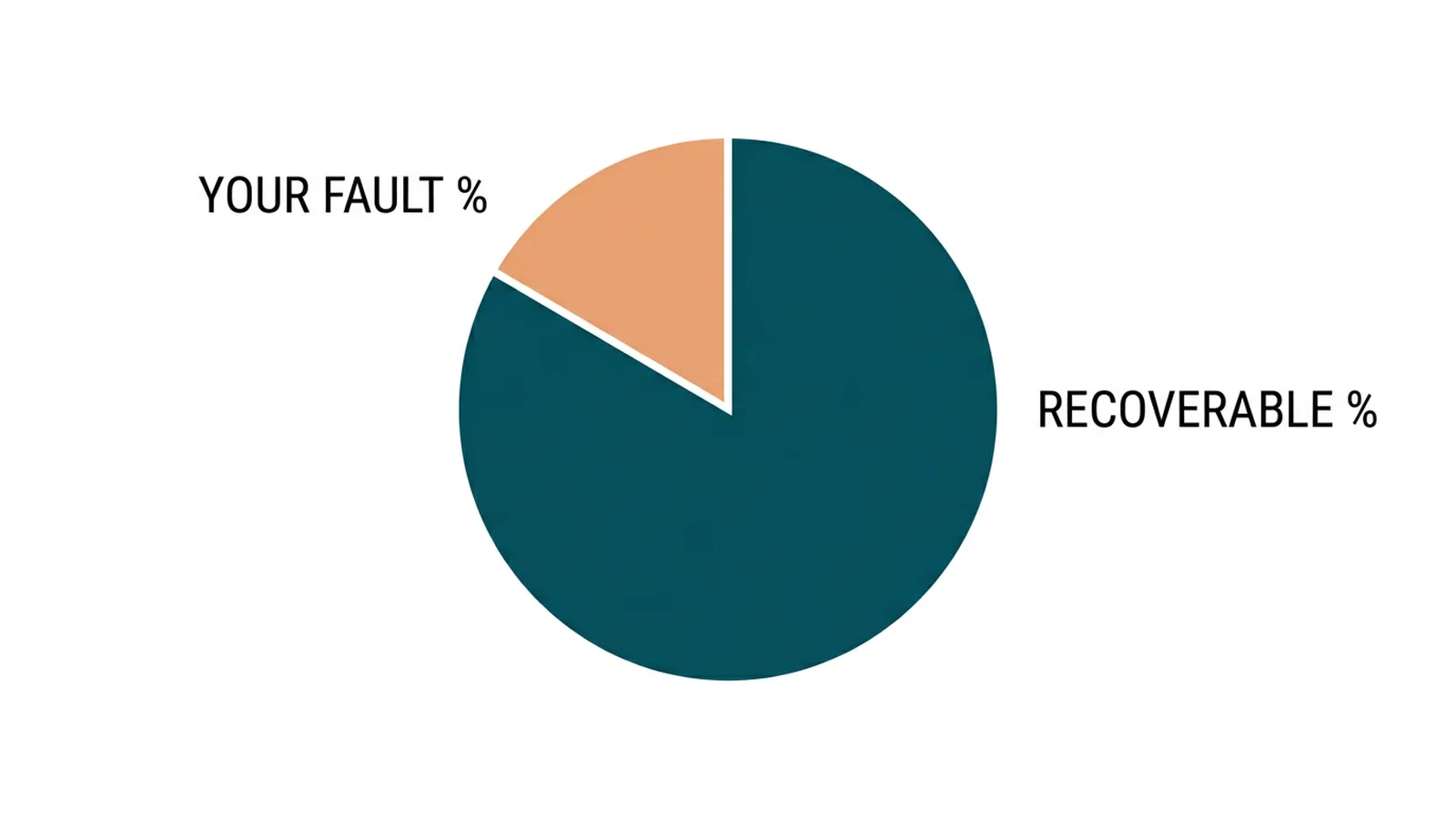
Here's the rule that makes all of that reasoning wrong in California. You can recover damages even if you were mostly at fault. Your recovery is reduced by your percentage of fault, not erased by it. Seventy percent at fault still leaves thirty percent.
That's what pure comparative negligence means, and it's why a case that looks like a dead end on the first phone call so often is not one.
You can recover damages even if you were mostly at fault. So your recovery is reduced by percentage of fault. For example, if you are 70% at fault, you can still recover 30% of your damages.
Ninety percent at fault still recovers ten
Fault gets assigned as a percentage, and that percentage comes off the top of your award. The math is straightforward. If a jury awards $100,000 in total damages and you're found 90 percent at fault, you still recover about $10,000.
The word doing the work in that name is pure, meaning there's no cutoff anywhere on the scale. Let's say you're 99 percent at fault. You're still entitled to that 1 percent. Out of a $100 claim, that's a dollar.
Most other states don't work this way. They enforce what's called a 50 percent bar, where you have to be able to prove the other driver was 51 percent at fault, and if you can't show you were 50 percent or less at fault, you're completely barred from any recovery. California sets no such bar, and I think that's pretty nice here. You're able to obtain whatever percentage of damages you're entitled to, even if it's only a dollar. You have the right to seek it and you have the right to fight for it.
The reduction hits everything equally, by the way. It comes off your economic damages, meaning your medical bills and your wage loss. It comes off your non-economic damages, the pain and the suffering that can't be calculated with a calculator. Both get brought down to the exact share of fault placed on the other driver. In a serious injury case, shedding just 10 or 20 percent of liability onto somebody else can easily be worth tens of thousands of dollars.
Which is exactly why we fight so aggressively on this one number. Every single percentage point of fault we push off of you is money they're forced to pay back to you.
Duty, breach, causation, damages
This is not an old rule. In 1975, the California Supreme Court decided a case called Li v. Yellow Cab Company, and that decision replaced the old harsh rule that wiped out a victim's claim if they were even 1 percent negligent. Before that, a sliver of blame ended the case. After it, a sliver of blame is a percentage.
It's worth knowing what has to be proven before any of that percentage math starts. Under California law, negligence is a four part formula. Duty, breach, causation, damages.
First, duty. Every driver on our roads owes a basic duty of care to look out for the safety of everybody else. Second, breach, which happens when a driver falls below that standard by doing something unsafe, like speeding, running a red light, or texting while driving. Third, causation, meaning that specific breach was the direct cause of the collision. And fourth, damages, the actual injuries and financial harm you suffered.
Liability only attaches if all four are proven together. Even if one is missing, the whole negligence claim fails.
I bring this up here because it's the reason a fault percentage is never a feeling. It's a legal test run on objective evidence, not a gut sense about who seemed careless at the scene. And nobody standing in the road that day has the final word on it. The responding officer's opinion, the adjuster's number, the other driver's version, those are all negotiating positions. The only entity that can officially and legally assign these percentages is a jury in a California Superior Court, Riverside or San Bernardino out here. Until a jury writes numbers on a verdict form, the percentages stay negotiable based on the strength of the evidence we bring.
A case where one percent made the difference
We had a client on a motorcycle who was mostly at fault for his own accident.
On the first read that's a case you don't take. But the question I ask myself is different. Is there even a 1 percent chance of arguing there's some comparative fault on the other driver? Is there anything I can pinpoint and find that they could have done to prevent this accident from happening in the first place?
There was, and it was only 1 percent. But because it was a motorcycle accident, the injuries were enormous. He was hospitalized with multiple fractures, and we were still able to collect the full policy limits available from the other side's insurance company.
I want to be precise about why that worked, because the number is easy to misread. One percent of comparative fault does not mean he recovered one percent of the case value. It means the case wasn't barred at all. Once the door was open, the size of the recovery tracked the severity of his injuries and the size of the policy available to pay, which are the same two things driving every claim in Chapter 7. Usually people hear 1 percent and think that's the recovery. It's the key, not the recovery.
That's one of the good things about California. Even if you're mostly at fault, if there's some sort of argument an attorney can make that the other side is partially at fault, even 1 percent, it can help with the compensation.
Finding that argument is work. It's reading the damage patterns, the light sequence, the black box data, the reconstruction described in Chapter 11. I think that's the part people don't picture when they write their own case off. It is not something you can do from the driver's seat five seconds after a crash, which is exactly when most people decide their case is worthless.
A related version of this comes up with seatbelts. Not wearing one counts against you under California's seatbelt defense and it will reduce your recovery. But it does not erase the claim. Not wearing a seatbelt is not what caused the crash. It may have made the injury larger, and the reduction reflects that, and then you recover the rest.
Common Questions
- Can I still file a claim if I was partially at fault for a car accident in California?
- Yes. California's pure comparative negligence rule lets you recover damages reduced by your percentage of fault, however high that percentage runs. There's no threshold above which recovery is barred. At 90 percent at fault you still recover 10 percent, and the reduction applies the same way to medical bills, wage loss, and pain and suffering.
- Does being mostly at fault mean my car accident claim is not worth pursuing?
- Not necessarily. We had a motorcycle client who was mostly at fault, and finding 1 percent of comparative fault on the other driver was enough to collect the full policy limits available, because his injuries were severe. A small share of fault, properly argued, doesn't cap the recovery at that share. It gets the claim through the door.
- Should I decide on my own that I was too much at fault to bother calling an attorney?
- No, and I urge clients never to disqualify themselves this way. Whether a case is viable is a question for someone trained to find the argument for shared fault in the evidence, not a gut sense of blame formed at the scene. Chapter 13 covers why a free consultation exists for exactly this call.
Chapter Reflection
What I want you to take from this chapter is who gets to do the math, which is not the officer, not the adjuster, and not you standing in the road replaying the last four seconds. Every number anyone puts on you before a verdict is a position, and positions move when evidence shows up. The percentage that finally counts is the one twelve people in Riverside or San Bernardino write on a verdict form, and most cases never get that far, because the evidence settles it first. So the worst version of this is somebody deciding on their own that a crash was their fault and never making the call. I would say that happens more than anything else in this book.