
There's a state reporting requirement after a car accident that runs completely separate from the police report, and almost nobody who hasn't been through a serious accident knows it exists.
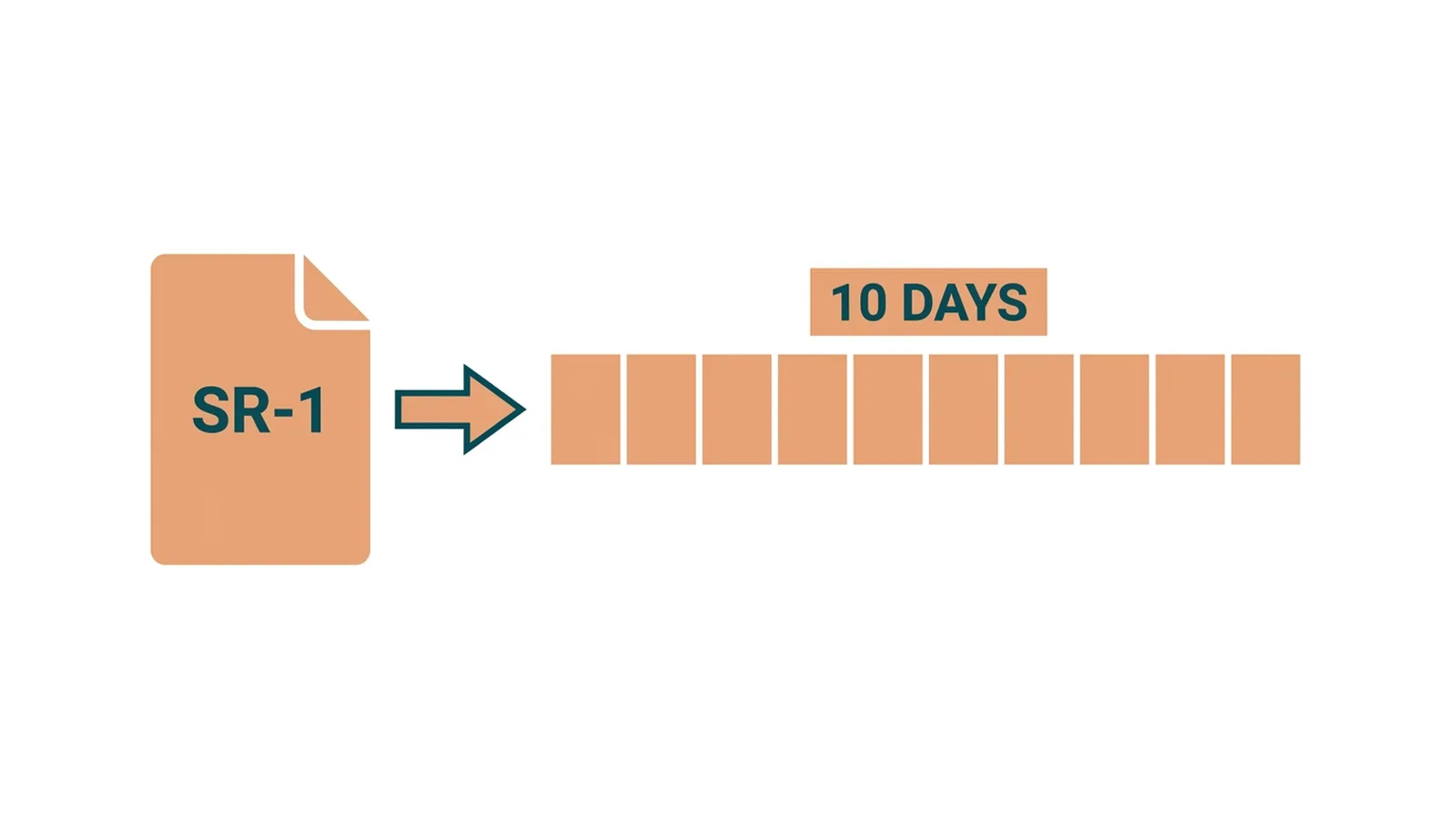
I call it by its number. The SR-1. It goes to the DMV, you have ten days, and it doesn't matter what your police report says or whether a police report exists at all.
It's a small piece of paperwork with a real penalty attached, and it's the single easiest thing in this book to get right, as long as somebody tells you about it in time. That's what this chapter is for.
And the number one, you can type it in on Google just DMV, California, DMV SR one, and usually like the first top link, there's actually a link where you can fill out everything out online. It used to be all manual and paper mailing, but now you can do it online and you have to fill that out within 10 days.
Three things trigger it
It is not every car accident, and three things trigger it.
Number one is any injuries. Number two is any deaths. Or number three, there's property damage over $1,000, regardless of who is at fault.
That third one is broader than people expect. It is not just damage to your car. It covers damage to anything outside the car, and it covers your personal belongings inside the car too. Let's say a laptop in the back seat, a bike on the rack, a mailbox you went into, things of that nature. So if you were in an accident and there are injuries, or there's damage over a thousand dollars, you need to report it to the California Department of Motor Vehicles within ten days.
And here's my actual advice, which is simpler than the rule. If you're not sure what the damages are, and you're not sure whether you're injured, it's always better to play on the safe side and just file it.
It only helps you. It does not hurt you to file it.
Think about what you're being asked to know inside ten days. Whether you're injured is a question a lot of people can't answer on day three, which is the whole point of the previous chapter. And whether the repair bill clears a thousand dollars is a question about a number you may not have yet. Ten days is also a tight window to know for certain whether repair costs will actually clear that $1,000 line, since a body shop estimate often takes longer than that to produce. Waiting to be certain is how the deadline passes.
A thousand dollars is also not much of a line anymore. I see that same number from the other direction all the time. In a small fender bender, where there's less than $1,000 worth of property damage repairs, just a scratch or a scrape or a little dent, a lot of times the insurance companies will deny the bodily injury claim altogether. They send a letter that says something like, due to the nature of the impact, we're denying the bodily injury claim.
So in the insurance world, under a thousand dollars is the definition of damage so minor they think you can't possibly be hurt. That's how low the SR-1 threshold sits. Modern repairs run well past it, which is the same pressure Chapter 4 describes on California's $15,000 property damage minimum. Most collisions worth documenting at all are going to cross this line.
How to file it in about ten minutes
It used to be all manual and paper mailing. It is not anymore.
Type "DMV California SR1" into Google. Usually the first top link takes you to a portal where you fill the whole thing out online and submit it. The form is spelled S as in Sam, R as in Robert, and then the number one, which matters because searching for the wrong thing is how people give up on it.
If you need help with it, your attorney should be able to do it for you. It's a routine thing for our office.
The consequence for missing the ten days is that you risk your license being suspended by the DMV. That's a real, functional penalty, and it arrives at the worst possible time, when there are already medical appointments to get to, a car in a shop, and an adjuster calling. Losing the ability to drive to any of it does not make the rest of the claim easier.
Where this sits on my list of the four biggest mistakes
When people ask me what hurts a claim most, I give them the same short list every time.
Number one, not seeking prompt medical care. Number two, missing deadlines, like filing the SR-1 or the government claim in time. Three, giving recorded statements to insurance companies. And number four is failing to document evidence.
I want you to notice where the SR-1 sits on that list. It's above recorded statements. It's above evidence. A missed deadline is in a different category from the other mistakes, because the others weaken a claim and a deadline can end one outright.
It's also the only mistake on that list you can make while doing everything else right. You can call the police, get checked out the next day, say nothing to the adjuster. You can hire a good lawyer. I think that's what makes it sting. And you can still get a suspension notice in the mail because of a form nobody mentioned. That's a frustrating way to be penalized, and it's entirely preventable with ten minutes and a browser.
You'll see this same instinct from me later on, when we get to the six month government claim deadline, which works the same way. When there's a filing window and any doubt at all about whether it applies to you, file. Don't sit there deciding. The cost of filing something you didn't strictly have to file is nothing. The cost of the reverse is the whole claim.
Why this exists whether or not an officer ever showed up
The DMV requirement runs on its own ten day clock, and that clock doesn't care what happened with law enforcement that day.
This is different from the police report, and the two don't substitute for each other. People hear "report the accident" and assume one covers the other. It does not work that way in either direction.
That distinction matters more out here than the plain text of the rule suggests. As Chapter 11 covers, in San Bernardino County, more likely than not the police are not going to come out, especially to something that looks like property damage only. Riverside is better about it, but you still usually have to say you're hurt before anyone is dispatched.
So picture the common version of this. No officer came. No report was written. Nobody documented anything except you. In that situation the SR-1 is the one mandatory record of the accident that exists at all, and it exists because you filed it. That's a decent reason to file even when you're on the fence.
Common Questions
- What's a SR-1 form in California, and when do I have to file one?
- The SR-1 is California's state accident report, and it's due within ten days if there's an injury, a death, or property damage over $1,000, no matter who was at fault. It goes to the DMV, separately from any police report, and it can be filed online now instead of by mail. The property damage figure covers your belongings and anything outside the car, not just the vehicle.
- What happens if I don't file my California SR-1 form within ten days?
- You risk your license being suspended by the DMV. If you're unsure whether your accident meets the threshold, file it anyway. It only helps you, it does not hurt you to file it, and it's a bad trade to lose a license over a repair estimate you couldn't get in time.
- Does filing the SR-1 replace a police report if officers never come to the scene?
- No, and neither one substitutes for the other. The SR-1 is a mandatory DMV filing that exists regardless of whether law enforcement responded. A police report is a separate document that insurance companies lean on heavily even though it is not admissible at trial, as Chapter 11 explains. Filing one doesn't excuse you from the other.
Chapter Reflection
Filing the SR-1 takes a few minutes online. Missing it can cost you your license. What makes it worth a chapter is that it's the first of several clocks that started running the moment your accident happened, and nobody is going to call and remind you about any of them. So if you're sitting there on the fence about whether your accident even qualifies, just file it. Ten minutes, a browser, and it's off your list.